






































































































































































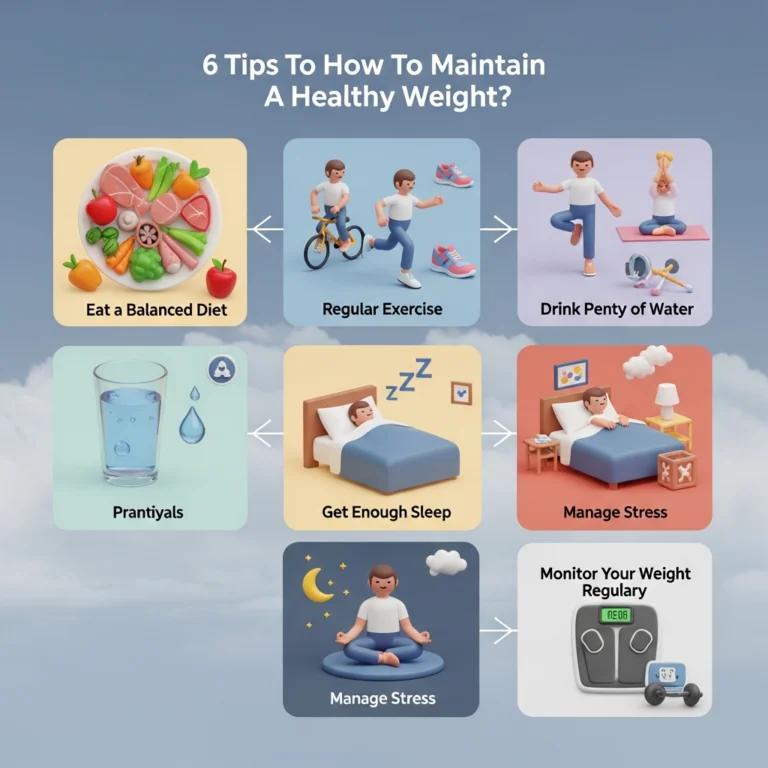
How to Maintain a Healthy Weight: 6 Practical Habits That Last
Author: RVLNSV PRASAD
Updated On: October 2026
About Us
Author Bio
Editorial Policy
Contact Us
Introduction
Maintaining a healthy weight is different from losing weight.
During weight loss, the goal is often clear: reduce body weight. Once you reach a weight that is appropriate for your health and personal circumstances, the challenge changes. You need habits that can fit into ordinary life without making every meal, workout, or weigh-in feel like a test.
That is where many weight-management plans fail.
A person may follow a strict diet for several weeks, lose weight, return to old eating patterns, become less active, and gradually regain some or all of the weight. This cycle can be frustrating, but it does not mean that the person lacks discipline.
Weight maintenance is influenced by food intake, physical activity, sleep, stress, medications, genetics, age, environment, appetite, and changes in energy requirements. The CDC’s current guidance also recognizes that factors such as sleep, age, genes, medications, and the surrounding environment can influence weight. CDC: Tips for Maintaining Healthy Weight
The more useful question is therefore not
“How can I follow the perfect diet forever?”
It is:
“How can I build a routine that keeps my weight reasonably stable while allowing me to live a normal life?”
This guide takes that approach.
It explains how to maintain a healthy weight using six practical habits, including a strategy for responding when your weight begins to creep upward. It also covers muscle preservation, sleep, emotional eating, weight tracking, common mistakes, and the latest research on preventing weight regain.
Quick Answer: How Can You Maintain a Healthy Weight?
The most sustainable approach is to build an eating pattern you can continue, remain physically active, protect sleep, maintain muscle, monitor meaningful changes, and respond early when your routine starts drifting.
You do not need to eliminate carbohydrates, skip dinner, drink special teas, or follow a complicated “metabolism-boosting” program.
NIDDK recommends a healthy eating pattern combined with regular physical activity for people who want to lose or maintain weight. Its guidance also emphasizes that maintaining weight loss can be difficult because energy requirements decrease as body weight falls and biological changes can make maintenance harder. NIDDK: Eating and Physical Activity to Lose or Maintain Weight
A practical framework is
- Build satisfying meals instead of relying on restriction.
- Keep everyday movement consistent.
- Use resistance training to protect muscle.
- Treat sleep and stress as part of weight management.
- Monitor trends rather than reacting to individual weigh-ins.
- Respond early when weight begins moving upward.
The goal is not perfect control but long-term stability built through realistic habits.
Key Takeaways
- Maintaining weight requires a long-term routine rather than a short-term diet.
- A healthy eating pattern is more useful than repeatedly starting restrictive diets.
- Protein, vegetables, fruits, whole grains, legumes, and other nutrient-dense foods can form the foundation of satisfying meals.
- Regular physical activity supports weight maintenance and provides health benefits beyond the scale.
- NIDDK recommends at least 150 minutes of moderate activity weekly for general health, with muscle-strengthening activity on at least two days; people trying to keep weight off may need more activity depending on individual circumstances. NIDDK: Keep Active and Eat Healthy
- Resistance training can help preserve fat-free mass during dietary weight loss.
- Sleep and stress can influence eating behavior and overall weight-management routines.
- Weekly or regular weight monitoring can help identify trends early.
- A small lapse does not mean the plan has failed.
- If weight begins increasing, making a small adjustment early may be easier than waiting for substantial regain.
- Unexplained weight changes or symptoms of a medical condition deserve professional evaluation.
- Healthy weight is not simply the lowest possible number on a scale.
What Does “Maintaining a Healthy Weight” Actually Mean?
Healthy weight does not mean that your scale must show exactly the same number every morning.
Body weight naturally moves because of changes in hydration, food in the digestive tract, sodium intake, bowel movements, glycogen, hormonal changes, and other factors.
A person might weigh slightly more after a restaurant meal without gaining a meaningful amount of body fat.
That is why weight maintenance should be viewed as a trend, not a single measurement.
The CDC explains that healthy weight management involves adequate nutrition, physical activity, and awareness of energy intake, while also recognizing that factors such as medications, age, sleep, and genetics can influence weight. CDC: Tips for Maintaining Healthy Weight
Weight Stability Is Not the Same as Perfection
Think of weight maintenance like maintaining a car’s speed on a long journey.
The goal is not perfect control but long-term stability built through realistic habits. In the same way, you do not constantly press the accelerator by the same amount; instead, you make small adjustments depending on the road.
Weight management can work similarly.
Your activity may decrease during a busy month. Your appetite may increase during a stressful period. Holidays may change your eating pattern. An injury may temporarily reduce exercise.
Instead of responding with an extreme diet, identify what changed and make a manageable correction.
That is one of the most useful principles for healthy weight maintenance.
The Six Habits That Make Weight Maintenance Easier
1. Build Meals That Keep You Satisfied
A major mistake is thinking that maintaining weight requires eating as little as possible.
It does not.
The better strategy is to build meals that provide enough nutrition and satisfaction to make your eating pattern realistic.
A practical meal can contain:
| Meal component | Examples |
|---|---|
| Protein | Dal, beans, eggs, fish, chicken, curd, tofu, paneer, soy |
| Vegetables | Spinach, carrots, cauliflower, beans, tomatoes, mixed vegetables |
| Fruit | Apple, orange, guava, berries, banana |
| High-fiber carbohydrate | Oats, whole grains, brown rice, whole-wheat roti, legumes |
| Healthy fat | Nuts, seeds, avocado, appropriate amounts of plant oils |
NIDDK recommends eating patterns that include vegetables, whole fruits, whole grains, and a variety of protein foods while limiting excess added sugars and saturated fat. NIDDK: Eating & Physical Activity to Lose or Maintain Weight
The exact combination does not have to look the same for everyone.
An Indian meal might be:
Dal + sabzi + roti + curd
Another person may prefer:
Eggs + vegetables + whole-grain toast + fruit
Someone eating mostly plant-based foods might choose:
Rajma + brown rice + vegetables + salad
The important idea is not a particular “weight-loss food.”
It is creating meals that are nutritious, satisfying, and practical enough to repeat.
The 3-Question Meal Check
Before making a meal more restrictive, ask:
- Does it contain a protein source?
- Does it contain a fiber-rich food?
- Will this meal keep me satisfied until my next normal eating opportunity?
If the answer is no, making the meal smaller may actually make later overeating more likely.
2. Keep Everyday Movement Consistent
Exercise is important, but maintaining a healthy weight is not only about scheduled workouts.
Your total daily movement matters too.
Walking to the shop, taking stairs, gardening, doing household work, walking during phone calls, and standing periodically can all contribute to your overall activity.
The CDC notes that physical activity helps with healthy-weight maintenance and provides benefits for cardiovascular health, sleep, muscles, bones, brain health, and physical function. CDC: Physical Activity and Your Weight and Health
For general health, adults are advised to aim for at least 150 minutes of moderate-intensity aerobic activity each week, along with muscle-strengthening activity on at least two days. CDC: Physical Activity and Your Weight and Health
However, there is an important people-first point here.
If you are currently inactive, jumping immediately to a demanding exercise program is unnecessary.
Start with something that fits your life.
The “Movement Replacement” Strategy
Instead of saying:
“I need to exercise for an hour.”
ask:
“Where can I add five to ten minutes of movement that I am currently not doing?”
Examples:
- Walk after lunch.
- Walk while speaking on the phone.
- Take the stairs when practical.
- Park slightly farther away.
- Stand and move during long periods of sitting.
- Take a short evening walk.
- Do simple household activities.
These changes may look small.
Their value comes from repetition.
3. Protect Muscle With Resistance Training
Weight maintenance is not only about the number on the scale.
Body composition matters too.
When someone loses weight, not every kilogram lost is necessarily body fat. Preserving lean mass is therefore an important part of a higher-quality weight-management approach.
A 2025 systematic review and meta-analysis of randomized trials found that adding resistance exercise during dietary weight loss helped preserve fat-free mass, increase fat-mass loss, and improve muscular strength compared with diet alone. PubMed: Resistance Exercise During Dietary Weight Loss
This does not mean you need a gym membership.
A simple home routine might include:
- Sit-to-stand from a chair
- Wall push-ups
- Resistance-band rows
- Supported squats
- Step-ups
- Hip hinges
- Calf raises
Start with an appropriate level of difficulty.
The goal is progressive improvement, not exhaustion.
A Simple Two-Day Strength Routine
Day A
- Chair squats
- Wall push-ups
- Resistance-band rows
- Calf raises
Day B
- Step-ups
- Supported hip hinges
- Wall or incline push-ups
- Resistance-band pulls
Allow recovery between sessions and adjust the exercises to your ability.
NIDDK recommends muscle-strengthening activities at least two days per week as part of its physical-activity guidance. NIDDK: Keep Active and Eat Healthy
4. Protect Sleep and Reduce Stress-Driven Eating
Sleep is sometimes treated as a separate wellness topic.
For weight maintenance, it makes more sense to treat it as part of the overall routine.
Poor sleep can make healthy choices more difficult for some people. Stress can also change eating patterns, activity levels, and food preferences.
The CDC includes adequate sleep and stress reduction among factors that support healthy weight management. CDC: About Healthy Weight and Growth
That does not mean:
“Sleep more and automatically lose weight.”
The relationship is more complicated; therefore, the practical goal is to protect sleep while reducing the behaviors that tend to appear when you are tired or stressed.
The Evening “Pause Before Eating” Method
If you frequently find yourself looking for snacks late at night, do not immediately label it emotional eating.
Pause for two minutes.
Ask:
- Am I physically hungry?
- Did I eat enough at dinner?
- Am I tired?
- Am I stressed?
- Am I eating because food is directly in front of me?
If you are hungry, a planned nutritious snack can be perfectly reasonable.
If the urge is mainly stress or boredom, try a short alternative first:
- Take a walk.
- Drink water or an unsweetened beverage.
- Call someone.
- Read for a few minutes.
- Take a shower.
- Prepare for bed.
The purpose is not to forbid food.
It is to create a small gap between an automatic urge and your decision.
5. Monitor Your Weight Trend Without Becoming Obsessed With the Scale
Monitoring can be useful when it helps you notice a trend early.
It becomes less useful when every small fluctuation causes anxiety.
NIDDK recommends keeping track of weight because monitoring can help people remain focused and identify setbacks earlier. It also emphasizes that a setback does not mean failure and that returning to healthy habits is important. NIDDK: Eating & Physical Activity to Lose or Maintain Weight
You can choose a method that feels comfortable.
Option 1: Weekly Weigh-In
Use the same general conditions each week and look at the trend over time.
Option 2: Weight Range
Instead of one “perfect” number, establish a reasonable range with a healthcare professional if appropriate.
Option 3: Broader Progress Check
Track:
- Weight trend
- Waist measurement
- Strength
- Fitness
- Energy
- Clothing fit
- Eating consistency
This can provide more context than the scale alone.
NIA also notes that body weight and BMI do not tell the entire story, particularly as people age, when muscle mass and body composition can change. National Institute on Aging: Maintaining a Healthy Weight
6. Act Early When Weight Starts Creeping Up
This is the habit that is often missing from generic healthy-weight articles.
People frequently wait until substantial weight has returned before changing anything.
A better strategy is to treat a small upward trend as information, not failure.
Suppose your weight has gradually increased for several weeks.
Do not immediately begin a crash diet.
Instead, ask:
- Has restaurant eating increased?
- Are portions larger?
- Have sugary drinks returned?
- Am I eating more snacks?
- Has my daily movement decreased?
- Am I sleeping poorly?
- Has work stress increased?
- Did I stop resistance training?
- Has a medication changed?
- Has an injury reduced my activity?
Once you identify the likely change, correct one or two behaviors first.
NIDDK specifically recommends returning to healthy habits after setbacks and describes weight monitoring as a useful way to catch changes early. NIDDK: Choosing a Safe and Successful Weight-Loss Program
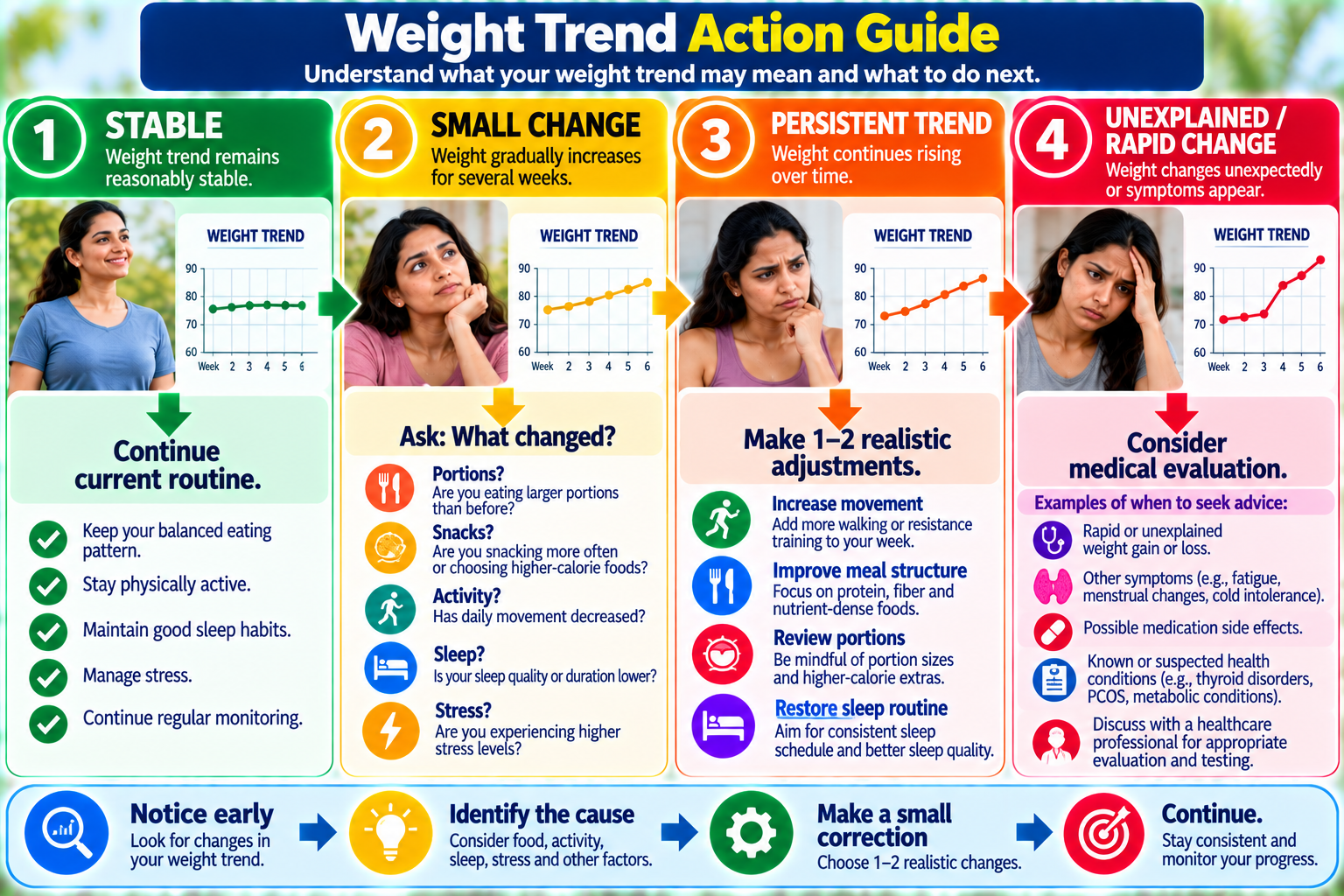
The Early-Correction Rule
Try this simple framework:
Stable weight
→ Continue your current routine.
Small upward trend
→ Identify what changed.
Persistent upward trend
→ Make a realistic adjustment.
Rapid or unexplained change
→ Consider medical evaluation.
This is more practical than waiting for a major regain and then starting another extreme diet.
A Better Way to Think About Portions
Portion control does not have to mean weighing every food.
Instead, learn your common “portion traps.”
For example:
| Situation | What can happen |
|---|---|
| Eating directly from a packet | Easy to lose track of quantity |
| Restaurant meals | Portions may be larger than expected. |
| Liquid calories | Drinks may add calories without much fullness. |
| Eating while distracted | Hunger and fullness signals may receive less attention. |
| Weekend meals | Intake can rise substantially without being noticed. |
| Healthy but calorie-dense foods | Nuts, oils, cheese, and spreads can add energy quickly. |
NIA notes that choosing the right amount of food for your activity level can be challenging and that portion size can be useful to consider when managing weight. NIA: How Much Should I Eat? Quantity and Quality
The goal is not to fear calorie-dense foods.
- It is to recognize them.
- A handful of nuts can be nutritious.
- So can olive oil.
- So can peanut butter.
But nutritious foods can still contribute substantial energy when portions become much larger than intended.
A Unique People-First Strategy: Find Your “Weight-Gain Trigger”
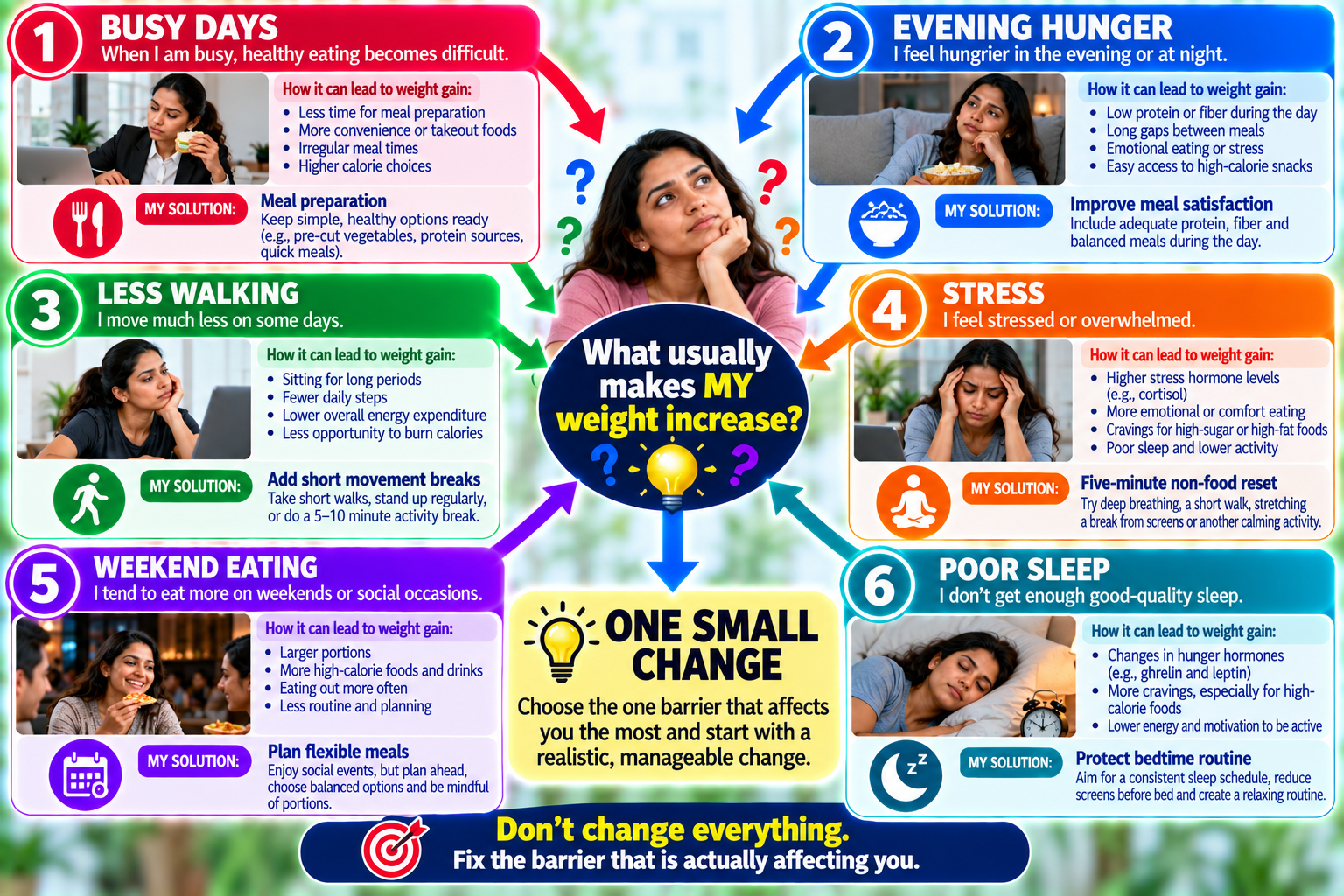
Instead of asking:
“Which diet should I follow?”
ask:
“What usually causes my weight to increase?”
Create your own trigger map.
| Your trigger | Possible response |
|---|---|
| Busy workdays | Prepare two simple meals in advance. |
| Evening hunger | Improve protein/fiber at dinner. |
| Restaurant meals | Decide your portion before eating. |
| Stress | Add a non-food five-minute stress break. |
| Less walking | Schedule short movement breaks. |
| Poor sleep | Protect a consistent bedtime. |
| Weekend overeating | Plan enjoyable foods rather than banning them. |
| Injury | Ask about safe alternative activities. |
This is different from generic advice because the intervention starts with your actual barrier.
There is no reason to change five habits when only one habit is causing the problem.
Emotional Eating: What to Do Without Blaming Yourself
Emotional eating is often described as a lack of self-control.
That framing is not particularly useful.
Food can become connected with stress, loneliness, boredom, celebration, fatigue, or habit.
The goal is not to remove emotion from eating.
Instead, notice the pattern.
Try the “Name Before You Eat” Method.
Before an unplanned snack, silently name what you are feeling:
Hungry.
Tired.
Stressed.
Bored.
Lonely.
Celebrating.
You can still choose to eat.
The difference is that the decision becomes more conscious.
If stress is the trigger, develop another response alongside food rather than trying to eliminate the feeling.
This might be a short walk, breathing exercise, conversation, music, journaling, or simply taking a break.
What to Eat for Long-Term Weight Maintenance
There is no single perfect weight-maintenance diet.
NIDDK recommends a healthy eating pattern that includes vegetables, fruits, whole grains, and varied protein foods while limiting excess added sugars and saturated fat. NIDDK: Eating & Physical Activity to Lose or Maintain Weight
A simple plate framework is
- ½ plate: vegetables and/or fruit
- ¼ plate: protein-rich food
- ¼ plate: whole grain or other high-fiber carbohydrate
Then add an appropriate amount of healthy fat.
For Indian meals, this could become:
Vegetables + dal/chana/rajma + roti or brown rice + curd
For a non-vegetarian meal:
Vegetables + fish/chicken/eggs + whole grain + fruit
For a vegetarian meal:
Vegetables + tofu/paneer/dal + whole grain + curd
The exact portions depend on individual energy needs.
What About Water?
Water is important for hydration, but it should not be marketed as a fat-burning remedy.
A particularly useful strategy is replacing sugary drinks with water or other unsweetened options when practical.
The CDC notes that water contains no calories and that replacing sugary drinks with plain water can help reduce calorie intake. CDC: Tips for Maintaining Healthy Weight
That is more useful than telling readers that lemon water or warm water “melts fat.”
You do not need a special morning drink to maintain a healthy weight.
What About Breakfast?
You do not have to force breakfast simply because someone says that breakfast “boosts metabolism.”
Some people enjoy breakfast and find that it helps them structure their day.
Others prefer a later first meal.
The more important question is whether your overall eating pattern is nutritious, satisfying, and compatible with your health needs.
Avoid turning breakfast into another weight-loss rule.
What About “Cheat Days”?
A full day of unrestricted eating can sometimes turn one flexible meal into a much larger intake than intended.
A better approach is planned flexibility.
You can enjoy:
- Restaurant food
- Dessert
- Festival meals
- Family celebrations
- Favorite snacks
without deciding that the entire day is “off plan.”
One meal does not determine your health.
The same principle applies after overeating.
Do not respond by starving yourself the next day.
Simply return to your usual eating pattern.
What the Latest Research Says About Weight Maintenance
The research around weight maintenance is becoming more nuanced; therefore, the focus is moving beyond simply asking:
“How much weight did someone lose?”
Researchers are increasingly asking:
“What helps people maintain those changes over time?”
Research Development 1: Long-Term Behavior Matters
A 2026 systematic review and meta-analysis examined 65 studies involving approximately 10,000 participants and found that behavioral interventions can support weight loss and weight maintenance, although effects vary between interventions. The study covered randomized trials with at least six months of follow-up. PubMed: 2026 Systematic Review of Behavior-Change Techniques for Weight Loss and Maintenance
This supports an important idea:
The skill of maintaining healthy behaviors matters as much as the initial weight-loss phase.
A plan that produces rapid results but cannot be continued may not be a good long-term strategy.
Research Development 2: Weight Regain Is a Real Biological and Behavioral Challenge
A 2026 systematic review of 29 randomized controlled trials examined recurrent weight gain after lifestyle interventions, bariatric surgery, and semaglutide treatment. The review illustrates how difficult long-term maintenance can be and how outcomes can differ depending on the intervention and what happens after treatment. PubMed: Recurrent Weight Gain After Weight Loss
This is important because weight regain should not automatically be interpreted as personal failure.
Biology, treatment continuation, environment, and behavior can all matter.
Research Development 3: Muscle Preservation Is Receiving More Attention
The quality of weight loss matters.
The 2025 meta-analysis of resistance exercise during dietary weight loss found benefits for preserving fat-free mass and improving strength while supporting fat-mass reduction. PubMed: Resistance Exercise During Dietary Weight Loss
That makes resistance training particularly relevant for people who have lost weight and want to protect physical function.
Research Development 4: Weight Maintenance Is Not Simply About Calories
Calories remain relevant because body weight is influenced by energy intake and energy expenditure.
But that does not mean weight maintenance can be reduced to a simple mathematical equation in real life.
NIDDK explains that metabolism changes during weight loss and that hormonal and other adaptations can make keeping weight off difficult. NIDDK: Eating & Physical Activity to Lose or Maintain Weight
This helps explain why maintaining weight can require ongoing attention even after someone has achieved a healthier weight.
A Simple Seven-Day Weight-Maintenance Reset
This is not a crash diet.
It is a way to identify which habits need attention.
Day 1: Observe
Do not change everything.
Record your meals, activity, sleep, and hunger.
Day 2: Upgrade One Meal
Add protein and a fiber-rich food to one meal that usually leaves you hungry.
Day 3: Add Movement
Take a 10-minute walk after one meal.
Day 4: Strength
Complete a short resistance-training session appropriate for your fitness level.
Day 5: Check Your Sleep
Identify one barrier.
Maybe it is late-night phone use, an inconsistent bedtime, or a stressful evening routine.
Day 6: Find Your Trigger
Ask:
What behavior most often causes my weight to increase?
Choose one practical response.
Day 7: Review
Look at:
- Hunger
- Energy
- Sleep
- Activity
- Meal quality
- Weight trend
- Strength
Keep what worked.
Ignore what was unrealistic.
That is how a routine becomes personal.
Common Mistakes That Make Weight Maintenance Harder
Mistake 1: Going Back to the Old Diet After Losing Weight
If the diet that produced weight loss was temporary, returning completely to previous habits can make regaining more likely.
Maintenance requires a transition to a sustainable routine.
Mistake 2: Eating Too Little
Extreme restriction may create hunger and make long-term adherence difficult.
NIDDK emphasizes choosing an eating plan that can be maintained over time. NIDDK: Eating and Physical Activity
Mistake 3: Exercising Only for Weight Loss
Physical activity has benefits beyond calorie expenditure.
It supports cardiovascular health, muscle, fitness, sleep, mental health, and physical function. CDC: Physical Activity and Your Weight and Health
Mistake 4: Ignoring Muscle
Weight can remain stable while body composition changes.
Resistance training can help protect fat-free mass during weight loss. PubMed: Resistance Exercise During Dietary Weight Loss
Mistake 5: Treating Every Scale Increase as Fat Gain
A single measurement can be affected by fluid, food, sodium, and other short-term changes.
Look at trends.
Mistake 6: Waiting Too Long to Respond
Small changes are often easier to address than major changes.
If your routine has clearly drifted, correct it early.
Mistake 7: Believing Every “Natural” Weight-Maintenance Remedy
Lemon water, detox drinks, special teas, and “metabolism boosters” are frequently promoted as shortcuts.
Healthy foods and drinks can certainly be part of a healthy lifestyle, but they should not be presented as magic solutions.
Mistake 8: Blaming Yourself for Every Regain
Weight regulation is influenced by more than willpower.
NIDDK and CDC both recognize multiple influences on weight, including biological, behavioral, environmental, and medical factors. CDC: Tips for Maintaining Healthy Weight
When Should You Talk With a Healthcare Professional?
Weight maintenance is usually a lifestyle issue, but sometimes a medical evaluation is appropriate.
Consider speaking with a healthcare professional if you experience:
- Unexplained or rapid weight change
- Persistent fatigue
- Major changes in appetite
- Excessive thirst or urination
- Significant menstrual or reproductive changes
- Symptoms suggesting thyroid disease
- New weight gain after starting a medication
- Difficulty managing diabetes or another chronic condition
- Unintentional weight loss
- Other persistent symptoms that concern you
NIA specifically notes that sudden unintended weight loss can sometimes signal an underlying medical problem and recommends professional evaluation. National Institute on Aging: Maintaining a Healthy Weight
Do not assume that every weight change is caused by a “slow metabolism.”
Likewise, do not assume that you need a hormone panel simply because your weight has changed.
What If You Are Taking a Weight-Loss Medication?
The maintenance conversation has become particularly important as medications targeting appetite and metabolic pathways become more widely used.
If you are taking a prescription weight-management medication, do not stop or change it simply because you have reached a particular weight.
Medication decisions should be made with your prescribing clinician.
Lifestyle habits still matter because eating patterns, physical activity, sleep, muscle preservation, and long-term monitoring remain important parts of comprehensive weight management.
The 2026 systematic review of recurrent weight gain after different weight-loss interventions also highlights why the period after initial weight loss deserves continued attention. PubMed: Recurrent Weight Gain After Weight Loss
My Personal Experience With Weight Maintenance
There was a period when my own weight changed repeatedly.
I tried strict approaches because they seemed like the fastest way to get results. The problem was that fast changes were difficult to maintain. Once the strict routine ended, it became easy to return to older habits.
Over time, I began to think differently about the problem.
Instead of asking what I could do for a few weeks, I started thinking about what I could realistically repeat.
That meant paying more attention to everyday meals, movement, sleep, and consistency rather than trying to make every day perfect.
The biggest lesson for me was simple:
A routine that you can repeat is more useful than a plan that only works when life is perfect.
That is also why I prefer a people-first approach to weight management.
A busy parent, an office worker, a student, an older adult, and someone recovering from an injury may need very different strategies.
There is no reason to force everyone into the same plan.
The “Minimum Healthy Day” Strategy
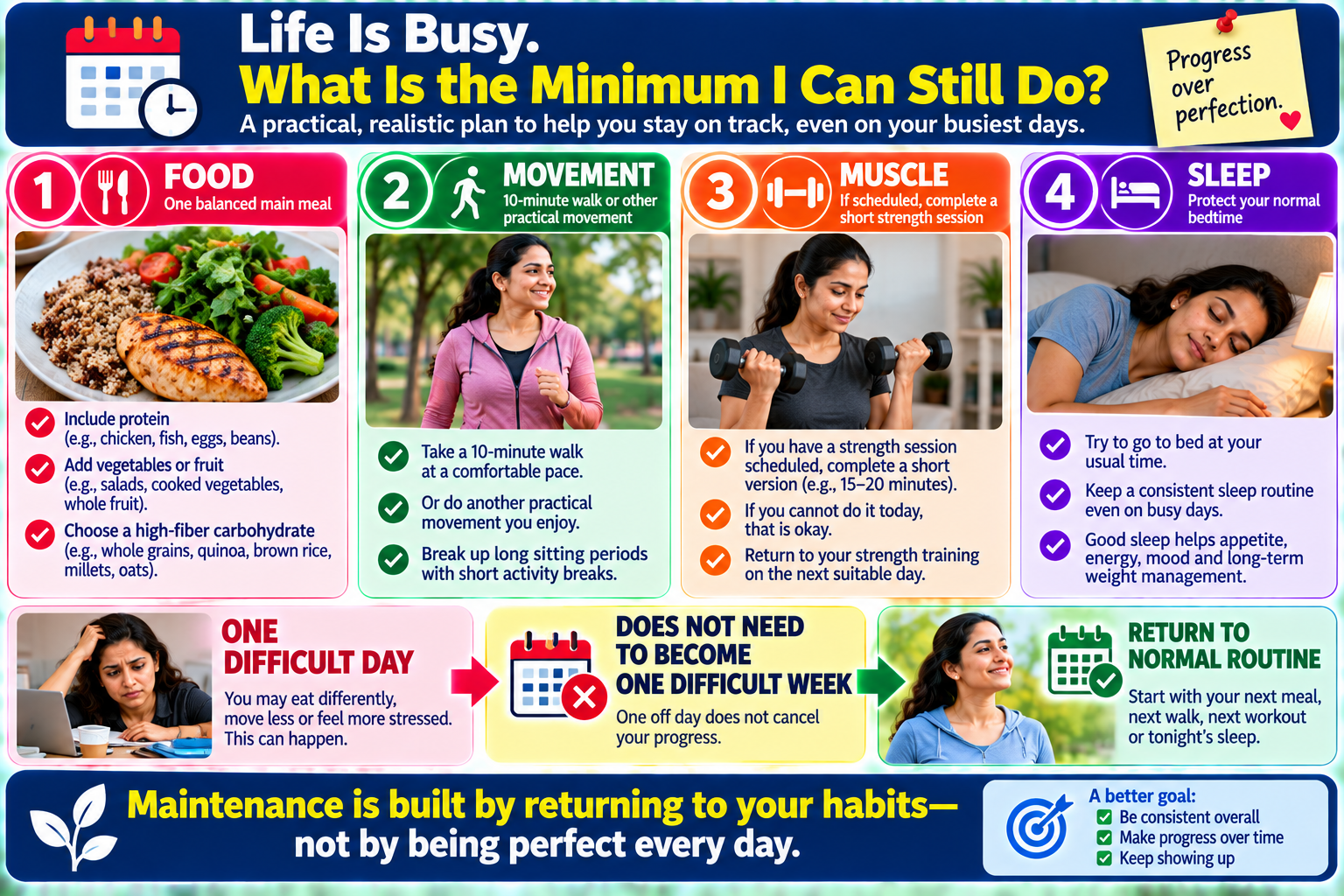
Here is another practical approach that can help during difficult weeks.
Instead of asking:
“What is the perfect healthy day?”
create your minimum healthy day.
On a busy day, your minimum might be
- One balanced main meal
- Some fruit or vegetables
- A short walk
- Enough water
- A reasonable bedtime
- No attempt to “make up” for missed exercise with extreme restriction
This is not the complete version of your lifestyle.
It is the version that prevents one difficult day from becoming one difficult month.
That small distinction can make long-term consistency easier.
A Practical Weight-Maintenance Checklist
Use this once a week:
Food
- ☐ Are most meals based on nutritious foods?
- ☐ Am I getting enough protein and fiber?
- ☐ Have portions gradually increased?
- ☐ Are sugary drinks or frequent snacks returning?
Movement
- ☐ Am I moving regularly?
- ☐ Has my daily activity decreased?
- ☐ Am I doing resistance training when appropriate?
Sleep
- ☐ Am I getting enough sleep for my needs?
- ☐ Has my schedule become irregular?
Stress
- ☐ Am I eating mainly because I am stressed or bored?
- ☐ Do I have a non-food way to take a break?
Progress
- ☐ Am I looking at a trend rather than one weigh-in?
- ☐ Has my waist or clothing fit changed?
- ☐ Has my strength changed?
Medical
- ☐ Have medications changed?
- ☐ Have new symptoms appeared?
If something has changed, address that specific issue rather than restarting an extreme diet.
Frequently Asked Questions
How can I maintain a healthy weight after losing weight?
Continue the eating and activity habits that helped you reach your new weight, while adapting them to your current energy needs. Regular physical activity, healthy food choices, and monitoring can help reduce the risk of regaining. NIDDK: Eating and Physical Activity to Lose or Maintain Weight
What is the best diet for maintaining weight?
There is no single diet that works for everyone. A sustainable eating pattern containing vegetables, fruits, whole grains, and varied protein sources is a strong foundation. The best approach is one you can follow consistently while meeting your nutritional needs. NIDDK: Eating and Physical Activity
How much exercise do I need to maintain my weight?
For general health, adults should aim for at least 150 minutes of moderate-intensity aerobic activity each week plus muscle-strengthening activity on at least two days. Some people may need more activity to maintain weight after weight loss. CDC: Physical Activity and Your Weight and Health
Can I maintain my weight without going to a gym?
Yes. Walking, cycling, dancing, home resistance exercises, gardening, and other activities can contribute to physical activity. A gym is an option, not a requirement. NIA: Maintaining a Healthy Weight
Should I weigh myself every day?
Not necessarily. Some people find frequent weighing useful, while others prefer weekly monitoring. The important point is to look for trends rather than reacting to every short-term fluctuation.
Why does weight come back after losing it?
Weight regain can occur because energy requirements change as body weight decreases, while appetite and other biological factors can also change. Behavioral and environmental factors may contribute as well. NIDDK: Eating and Physical Activity to Lose or Maintain Weight
Is resistance training useful for weight maintenance?
Yes. Resistance training helps develop and preserve muscle and can be particularly useful during and after weight loss. Evidence from randomized trials supports resistance exercise for preserving fat-free mass during dietary weight loss. PubMed: Resistance Exercise During Dietary Weight Loss
Can drinking water help maintain weight?
Replacing sugary drinks with water can reduce calorie intake because water contains no calories. Water itself should not be treated as a fat-burning remedy. CDC: Tips for Maintaining Healthy Weight
What should I do if I gain a few pounds?
First, do not panic. Look at the trend and identify what changed. Check portions, snacks, drinks, activity, sleep, and stress. If the upward trend continues, make a small adjustment rather than starting an extreme diet.
Is weight maintenance the same for everyone?
No. Age, genetics, medications, health conditions, activity level, food environment, sleep, and many other factors can affect weight. CDC: Tips for Maintaining Healthy Weight
Final Thoughts
Maintaining Weight Is a Skill, Not a Short-Term Diet
Learning how to maintain a healthy weight is not about finding a perfect meal plan and following it forever.
It is about building a system that can survive ordinary life.
- Some days will be busy.
- Some meals will be larger than planned.
- You may miss workouts.
- You may sleep badly.
- You may gain a little weight during a holiday or stressful period.
None of these events means that your entire plan has failed.
The important skill is knowing how to return to your normal routine.
Focus on Small Corrections
A sustainable approach looks more like
Notice → understand → adjust → continue
rather than:
Overeat → feel guilty → crash diet → quit → repeat
Healthy weight maintenance is therefore not about perfection.
It is about reducing the number of times you need to start over.
Protect Health, Not Just a Number
Weight is one health measure.
It is not the entire picture.
Physical fitness, strength, sleep, blood pressure, blood glucose, nutrition, mental well-being, and the ability to perform everyday activities also matter.
NIA notes that body weight and BMI provide only part of the picture, particularly as people age, when body composition and muscle mass become increasingly important. National Institute on Aging: Maintaining a Healthy Weight
The latest research also supports a broader view of weight maintenance, with increasing attention to sustained behavior change, muscle preservation, and the biological difficulty of preventing weight regain. 2026 Systematic Review of Behavior-Change Techniques
The most useful goal is therefore not
“How can I control my weight perfectly?”
It is:
“How can I build healthy habits that are realistic enough to continue, and what can I do when life knocks me off track?”
That is a much more practical way to think about long-term healthy weight maintenance.
Author Note
This article focuses on practical, evidence-informed strategies for maintaining a healthy weight rather than promoting restrictive diets, detox products, or quick fixes.
The goal is to help readers understand that long-term weight management involves more than food alone. Physical activity, sleep, stress, muscles, medications, health conditions, environment, and individual circumstances can all influence the process.
The practical strategies in this article are intended to be adaptable rather than treated as a rigid prescription for everyone.
Medical Disclaimer
This article is for general educational purposes and does not diagnose, treat, or prevent any disease.
A “healthy weight” is individual and can depend on age, health conditions, medications, body composition, and other factors.
If you experience unexplained weight loss or gain, persistent fatigue, significant changes in appetite, symptoms of thyroid disease, diabetes symptoms, menstrual or reproductive changes, or another concerning health change, speak with a qualified healthcare professional.
Do not stop prescription medication or make major dietary changes based solely on this article.
Fitness Disclaimer
Physical activity should match your current fitness level, health status, and physical abilities.
If you are new to exercise, start gradually and increase activity over time.
People with heart disease, diabetes, high blood pressure, significant joint problems, recent surgery, or other medical conditions should discuss appropriate exercise with a healthcare professional when necessary.
Stop exercise and seek appropriate medical attention if you develop concerning symptoms such as chest pain, fainting, severe shortness of breath, or unusual pain.
Sources
- NIDDK — Eating & Physical Activity to Lose or Maintain Weight
- NIDDK—Keep Active & Eat Healthy to Improve Well-being & Feel Great
- NIDDK — Choosing a Safe & Successful Weight-Loss Program
- CDC—Tips for Maintaining Healthy Weight, updated March 2026
- CDC—About Healthy Weight and Growth, updated August 2026
- CDC—Physical Activity and Your Weight and Health, updated April 2026
- National Institute on Aging — Maintaining a Healthy Weight
- National Institute on Aging — How Much Should I Eat? Quantity and Quality
- PubMed—2026 Systematic Review and Meta-Analysis of Behavior-Change Techniques for Weight Loss and Maintenance
- PubMed—Recurrent Weight Gain After Lifestyle Intervention, Surgery or Semaglutide
- PubMed — Resistance Exercise During Dietary Weight Loss, 2025
- PubMed — Updated Systematic Review of Nonsurgical Weight-Loss Maintenance Interventions
- American Heart Association — Keeping a Healthy Body Weight
- Cleveland Clinic — Maintaining Weight Loss and Building Muscle
You also Like
Healthy Daily Habits for Stress Reduction: A Comprehensive Guide
4 Week Diet Plan for Weight Loss
A Holistic Guide to Healthy Lose Weight
3 Best Tips To Maintain Fitness










[…] 6 Tips To How To Maintain A Healthy Weight ? […]
[…] 6 Tips To How To Maintain A Healthy Weight ? […]
[…] 6 Tips To How To Maintain A Healthy Weight ? […]
[…] 6 Tips To How To Maintain A Healthy Weight ? […]